
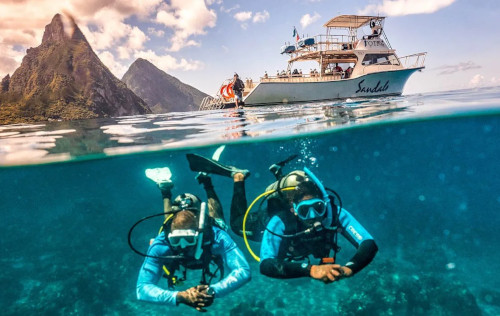
PADI Boat Diver
If you’re new to boat diving or want to learn more about diving from different types of boats, enroll in the PADI® Boat Diver course.
Availability: Contact us for booking information
During two dives with an instructor you’ll learn nautical terminology, boat diving etiquette and may practice using lines and/or deploy a surface marker buoy (SMB).
What You'll Learn
- Pack for a boat trip
- Properly stow your gear
- Manage seasickness
Certification Requirements
Prerequisites
- PADI (Junior) Open Water Diver (or qualifying entry-level-certification)
Time
- PADI eLearning: 2-4 hours
- Entire course: 1-2 days
Age and Health
- 10 years or older
- Good physical health
Why Take the PADI Boat Diver Course?
If you love to travel, the PADI Boat Diver Specialty course will prepare you to dive from small inflatables all the way up to large liveaboards. Learn how to enter and exit the water, use current lines and manage seasickness.
Step 1 - PADI eLearning®
PADI eLearning makes it easy to fit scuba lessons into a busy schedule. Complete the independent study part of your course whenever, wherever it’s convenient for you.
Work at your own pace, online or offline, using a computer or mobile device. Connect with your instructor for inwater training, or whenever you have a question.
eLearning time commitment: 2-4 hours
Step 2 - With Your Instructor
You'll make two dives from a boat where you’ll practice entering and exiting the water and properly stowing your gear. Your instructor will also teach you about local boat diving etiquette and safety procedures.
Total time commitment: 1-2 days
Boat Diver FAQs
What are nautical phrases?
Nautical phrases are specialized terms and expressions used by sailors, boaters, and divers to communicate effectively while on the water. These phrases often relate to directions, navigation, equipment, and conditions at sea. For example, terms like “port” (left side of the boat), “starboard” (right side of the boat), and “aft” (rear of the boat) are essential for clear communication during maritime activities. Nautical phrases help ensure safety and efficiency in maritime operations, especially when conducting activities like diving, sailing, or navigation in open waters.
What are diving boats called?
Diving boats are typically referred to as “dive boats”. These specialized vessels are designed to support scuba divers during their underwater excursions. Dive boats come equipped with features such as dive platforms, air tanks, and sometimes even dive ladders to assist divers entering and exiting the water. Depending on the dive location, dive boats can vary in size, from smaller vessels for local shore dives to larger boats used for offshore or liveaboard diving trips. Dive boats are essential for getting divers to and from dive sites, particularly in areas where shore diving is not feasible.
What is boat diving?
Boat diving is a scuba diving method where divers board a boat to reach dive sites that are located far from shore. This type of diving allows access to remote or deeper dive sites, such as offshore reefs, wrecks, or drop-offs, which cannot be easily reached by shore diving. Boat diving typically involves the boat being anchored near the dive site, where divers enter the water from the boat, often using a ladder or dive platform. Boat diving is popular in areas with strong currents, deep dive locations, or when exploring distant sites with rich marine biodiversity.
What is a surface marker buoy used for?
A surface marker buoy (SMB) is a safety device used by divers to signal their location to surface boats or other vessels while diving. It is typically a brightly colored inflatable buoy attached to a rope, which floats at the surface of the water, indicating the diver’s position below. SMBs are especially important in situations where visibility is low, or divers are out of sight of the boat. They help prevent accidental collisions with boats and are used during decompression stops or when drifting during a drift dive. A delayed surface marker buoy (DSMB) is deployed at depth and ascends with the diver, signaling their location while they are still submerged.
Which is better, shore diving or boat diving?
Shore diving and boat diving each offer unique advantages, depending on a diver’s preferences, experience level, and the specific dive site. Shore diving is generally easier and more cost-effective since it doesn’t require a boat ride; divers can often simply walk into the water from the beach or shoreline. This makes shore diving ideal for beginners or those who prefer a more relaxed and convenient diving experience. In contrast, boat diving provides access to more remote or deeper dive sites that are difficult or impossible to reach from shore. It allows divers to explore underwater locations such as offshore reefs, wrecks, or drop-offs, expanding the variety and adventure available. While boat diving can be more expensive due to the cost of the boat ride, it offers greater opportunities for exploration. Ultimately, choosing between shore and boat diving depends on what type of underwater experience the diver seeks and their comfort level with the conditions at each site.

