
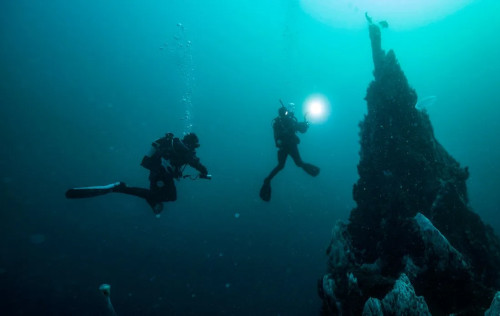
PADI Deep Diver
During the PADI® Deep Diver course, you'll learn how to plan deep dives, manage your gas supply and how to identify and manage narcosis.
You'll learn about buddy contact procedures, safety considerations and buoyancy control at depth.
Availability: Contact us for booking information
What You'll Learn
- Manage your gas supply
- Identify and deal with narcosis
- Recognize your personal limits
Certification Requirements
Prerequisites
- PADI Adventure Diver (or qualifying certification)
Time
- PADI eLearning: 2-4 hours
- Entire course: 2-3 days (dives must be completed over a minimum of two days)
Age and Health
- 15 years or older
- Good physical health
How to Start Deep Diving
When you dive below 18 metres/60 feet, there are special safety considerations. If you're ready to expand your boundaries, a PADI Instructor will help you gain the skills and confidence to explore to a maximum depth of 40 metres/130 feet.
Step 1 - PADI eLearning
PADI eLearning makes it easy to fit scuba lessons into a busy schedule. Complete the independent study part of your course whenever, wherever it's convenient for you. Work at your own pace, online or offline, using a computer or mobile device. Connect with your instructor for inwater training, or whenever you have a question.
eLearning time commitment: 2-4 hours
Step 2 - With Your Instructor
During four dives with a PADI Instructor, you'll practice descents, buoyancy and safety stops. Through hands-on exercises, you'll discover how deep dives affect color, physical objects and your brain.
Total time commitment: 2-3 days (dives must be completed over a minimum of two days
Deep Diver FAQs
What is deep sea diving called?
Deep sea diving is commonly referred to as technical diving, saturation diving, or recreational deep diving, depending on the context. Technical diving involves going beyond typical recreational depth limits (usually deeper than 40 meters or 130 feet) and requires specialized training, equipment, and breathing gases to manage the increased risks. Saturation diving, used mainly in professional and commercial operations, allows divers to live and work at depth for extended periods in pressurized environments, reducing the need for frequent decompression. In recreational diving, 'deep diving' typically refers to dives beyond 18 meters (60 feet), though these do not always require the advanced techniques used in technical or saturation diving.
Medical Requirements
Scuba diving requires a minimum level of health and fitness. Chronic health conditions, certain medications and/or recent surgery may require you to get written approval from a physician before diving.
Avoid disappointment, download and review the Diver Medical form to ensure you won’t need a physician’s approval to dive before enrolling in a scuba course. Instructors, divemasters and dive shop staff are not physicians and should not be asked for medical advice; only medical professionals can give medical clearance to dive.
If you (or your physician) have questions about medical fitness to dive, contact the experts at Divers Alert Network (DAN).
Prerequisites & Minimum Age
Minimum Age: 15, Course prerequisites: PADI Adventure Diver (or qualifying certification)
Time Commitment Details
PADI eLearning: 2-4 hours, Entire course: 2-3 days (dives must be completed over a minimum of two days)
What is the difference between deep sea diving and scuba diving?
The main difference between deep sea diving and scuba diving lies in the depth, equipment, and purpose. Scuba diving—short for Self-Contained Underwater Breathing Apparatus—is typically a recreational activity limited to depths of around 40 meters (130 feet), where divers use air tanks and carry their own breathing gas. In contrast, deep sea diving goes far beyond recreational limits, often exceeding 100 meters, and involves specialized equipment like surface-supplied air systems or atmospheric diving suits that can withstand extreme pressure. While scuba diving focuses on exploration and enjoyment of underwater environments such as reefs and wrecks, deep sea diving is usually conducted for professional purposes like underwater construction, scientific research, or exploration, and requires advanced technical training and support systems.
How deep do you go in deep sea diving?
Deep sea diving typically refers to diving at depths greater than 60 feet (18 meters), with limits varying based on the type of diving and the diver’s training. Recreational deep diving usually reaches a maximum depth of 130 feet (40 meters), requiring certifications such as Advanced Open Water or Deep Diver. Technical diving, which goes beyond recreational limits, can reach depths of over 330 feet (100 meters) and demands specialized training, equipment, and gas mixtures to manage the increased risks. In extreme cases, such as record-setting dives, divers have descended as deep as 1,090 feet (332 meters) using open circuit scuba gear. The deeper the dive, the greater the need for precise planning to handle challenges like increased pressure, nitrogen narcosis, and the risk of decompression sickness.
What does PADI consider a deep dive?
PADI (Professional Association of Diving Instructors) defines a deep dive as any dive that exceeds 18 meters (60 feet). While entry-level divers certified through the Open Water Diver course are limited to 18 meters, those with an Advanced Open Water Diver certification can dive to depths of up to 30 meters (100 feet). For those seeking to explore even deeper within recreational limits, the PADI Deep Diver Specialty course allows certified divers to reach a maximum depth of 40 meters (130 feet). This course equips divers with the training needed to handle the challenges of deeper diving, such as decompression planning, managing nitrogen narcosis, and using appropriate equipment like dive computers and redundant air supplies.
What does deep diver mean?
A deep diver is someone trained and certified to dive beyond standard recreational depth limits, typically referring to dives deeper than 30 meters (98 feet). In recreational diving, agencies like PADI consider any dive between 18 and 40 meters (60 to 130 feet) as a deep dive, with the PADI Deep Diver Specialty course qualifying divers to reach the maximum recreational depth of 40 meters (130 feet). However, the term 'deep diver' can also apply to individuals engaged in technical or commercial diving, where depths exceed 40 meters and require advanced training, specialized breathing gases like trimix or heliox, and complex equipment. These divers often operate in environments with greater risks and longer bottom times, such as underwater construction or deep-sea exploration.

