
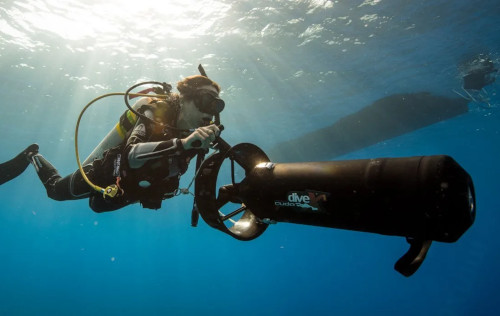
PADI Diver Propulsion Vehicle
If scuba diving is like taking a scenic stroll around a park, a Diver Propulsion Vehicle (DPV) is like exploring a neighborhood on an (electric) bicycle.
Availability: Contact us for booking information
DPVs, also called underwater scooters, allow you to see more, conserve air and get from one place to another faster - with a huge smile on your face.
What You'll Learn
- Handle a DPV
- Manage your depth
- Avoid problems
Certification Requirements
Prerequisites
- PADI (Junior) Open Water Diver (or qualifying entry-level-certification)
Time
- PADI eLearning: 2-4 hours
- Entire course: 1-2 days
Age and Health
- 12 years or older
- Good physical health
DPV Diving: See More, Swim Less, Smile Big
Scuba diving with a DPV is some of the most fun you can have underwater. During the PADI® Diver Propulsion Vehicle course, you’ll be surprised how much you can see on one tank of air. Your instructor will show you different maneuvers and answer any questions you have.
Step 1 - PADI eLearning®
Start your DPV course online and progress at your own pace, online or offline, using a computer or mobile device.
Learn about different types of underwater scooters, their care and maintenance and how to use a DPV when diving with a buddy. If you’re thinking about buying a DPV, this course is a great place to start.
eLearning time commitment: 2-4 hours
Step 2 - With Your Instructor
During two exhilarating dives, you’ll practice DPV maneuvers and tandem riding. Learn how to avoid problems like ascending/descending too fast, motor entanglements, losing track of your buddy and running out of battery power.
Total time commitment: 1-2 days
Diver Propulsion Vehicle FAQs
What is an underwater scooter called?
An underwater scooter is commonly known as a Diver Propulsion Vehicle (DPV). These innovative devices are used by divers to propel themselves through the water, reducing the effort needed for swimming and allowing for longer dives or the exploration of larger underwater areas. DPVs are popular among recreational divers, technical divers, and commercial divers due to their ability to increase mobility and conserve energy. They typically consist of a handle, motor, and propeller, and are powered by rechargeable batteries. Some models are compact and lightweight, designed for personal use, while others are larger and more powerful, suitable for professional or military diving applications. DPVs are also referred to by brand names like Seascooter or Diver Scooter.
What is a DPV in scuba diving?
A Diver Propulsion Vehicle (DPV) in scuba diving is an underwater scooter that helps divers move more efficiently through the water. It is a powered device that allows divers to cover greater distances with less physical exertion, making it especially useful for exploring large dive sites or for conserving air during long dives. DPVs typically consist of a motor, propeller, handlebar, and a battery, and they are designed to be easy to control while offering stable propulsion. DPVs come in different sizes and power levels, ranging from lightweight models for recreational divers to heavy-duty models for technical or commercial diving operations. They are invaluable tools for deep-sea exploration, wreck diving, cave diving, and underwater photography, enhancing both safety and enjoyment for divers.
How much is a diver propulsion vehicle?
The cost of a Diver Propulsion Vehicle (DPV) can vary greatly depending on the brand, size, features, and power capabilities. On average, a basic recreational DPV can cost anywhere from $1,000 to $3,000. These models are usually compact and designed for personal use in recreational diving. For more advanced or professional DPVs, such as those used in technical or commercial diving, the price can range from $3,000 to $10,000 or more. High-end DPVs with greater speeds, longer battery life, and additional features like GPS tracking, underwater lights, or depth capabilities can exceed $10,000. It’s essential to consider factors like the type of diving you plan to do and the equipment’s features when choosing the right DPV.
What are the different types of DPV?
There are several types of Diver Propulsion Vehicles (DPVs) designed for different diving needs and environments. The main categories include: - Recreational DPVs: Compact and easy to use, ideal for leisure divers exploring shallow waters or coral reefs. Lightweight with shorter battery life and speeds of 2 to 3 knots. - Technical Diving DPVs: Designed for technical divers with higher speeds, longer battery life, and deeper depth ratings. Common in cave or wreck diving. - Commercial/Heavy-duty DPVs: Built for professional use with increased power, extended range, and capacity for extra equipment or multiple divers. Used in construction, recovery, and military. - Mini DPVs: Small, portable, and good for short distances. Preferred by divers looking to reduce gear weight. Each type is tailored for specific use cases, so divers should choose based on dive type, frequency, and goals.
What is the top speed of the diver propulsion vehicle?
The top speed of a Diver Propulsion Vehicle (DPV) varies based on the model and intended use. Recreational DPVs usually reach speeds of 2.5 to 4 knots (approximately 2.8 to 4.6 mph or 4.6 to 7.4 km/h), which is sufficient for casual dives. Technical or commercial DPVs can achieve speeds of 5 to 6 knots (5.7 to 6.9 mph or 9.2 to 11.1 km/h). High-performance models for military or professional use may reach 7 knots (around 8 mph or 12.9 km/h), though these are uncommon in recreational settings. Speed is typically balanced with battery life, as higher speeds reduce runtime.

